 by
by Fjord landscapes are among the most breathtaking natural environments on Earth. Carved by glaciers over thousands of years, these dramatic formations feature towering cliffs, deep waterways, cascading waterfalls, and rugged mountain peaks. Whether you are exploring the famous fjords of Norway, the spectacular fiords of New Zealand, or the remote fjord regions of Alaska and Patagonia, one challenge consistently faces photographers: conveying the immense scale of what they see.
Standing at the edge of a fjord, you may feel dwarfed by mountains rising nearly vertically from the water. Yet when you review your photographs later, the scene often appears smaller and less impressive than it felt in person. The camera captures the beauty but not always the grandeur.
This is a common problem in landscape photography. Human vision naturally interprets depth, distance, and proportion, while a camera compresses a three-dimensional world into a two-dimensional image. As a result, massive cliffs may look like ordinary hills, and enormous waterfalls may appear surprisingly modest.
Fortunately, photographers can use specific techniques to communicate scale effectively. By understanding composition, perspective, light, and storytelling, you can create images that preserve the sense of awe that makes fjord landscapes so memorable.
Why Scale Is Important in Fjord Photography
Scale gives viewers context.
Without a recognizable reference point, it is difficult to understand how large or small something truly is. A mountain photographed in isolation may look impressive, but viewers cannot accurately judge its size.
In fjord environments, scale is especially important because these landscapes are defined by their enormity.
Some fjord cliffs rise more than a thousand meters above the water. Waterfalls can plunge hundreds of meters down sheer rock faces. Glacial valleys stretch for miles between mountain walls.
Capturing scale helps viewers appreciate:
- The size of the landscape
- The power of geological processes
- The relationship between humans and nature
- The emotional impact of the environment
A successful fjord photograph allows viewers to feel the vastness rather than merely see it.
Include People in the Frame
One of the simplest and most effective ways to show scale is to include a human subject.
People provide an immediate size reference because viewers instinctively understand human proportions.
Imagine a photograph of a massive cliff. Without context, the cliff could be 100 feet tall or 1,000 feet tall. Add a tiny hiker standing on a ledge, and the true scale becomes obvious.
When using people to establish scale:
- Keep the person relatively small in the frame.
- Position them where they are visible but not dominant.
- Use bright clothing if the landscape is dark or complex.
- Allow the surrounding scenery to remain the primary focus.
A lone traveler gazing across a fjord often creates both scale and emotional connection.
Use Boats as Natural Reference Points
Fjords are defined by water, making boats excellent tools for illustrating scale.
Even small boats can dramatically improve a composition.
Examples include:
- Kayaks
- Fishing vessels
- Sailboats
- Ferries
- Cruise ships
A tiny kayak paddling beneath a towering cliff immediately reveals the enormous size of the surrounding landscape.
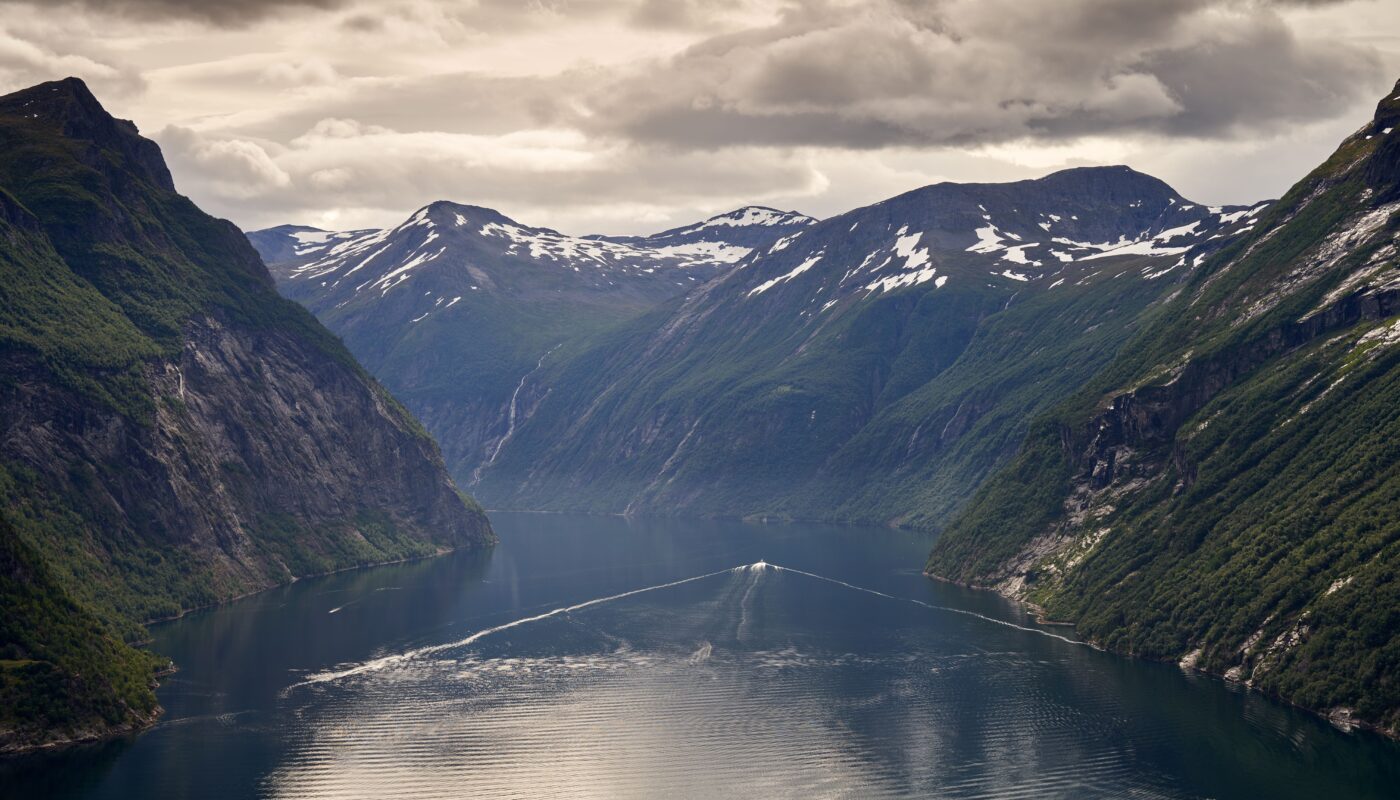
Interestingly, even large cruise ships can appear surprisingly small against fjord walls, emphasizing the immense dimensions of the terrain.
Patience can be valuable. Waiting for a boat to enter the scene may transform an ordinary image into an extraordinary one.
Create Depth with Foreground Elements
Many landscape photographs fail because they lack depth.
Foreground elements help establish a sense of distance and scale by creating multiple visual layers.
Useful foreground subjects include:
- Rocks
- Wildflowers
- Driftwood
- Grass
- Trees
- Shoreline features
By placing a foreground object close to the camera, you create a visual journey through the image.
The viewer’s eye moves from:
- Foreground
- Midground
- Background
This layered composition enhances the perception of distance and makes the landscape feel larger.
Photograph from Elevated Viewpoints
One of the best ways to communicate scale is to photograph from above.
Elevated viewpoints reveal relationships between landscape features that may not be visible from lower positions.
From a high vantage point, you may capture:
- Tiny villages beside huge mountains
- Roads winding along cliff edges
- Boats crossing expansive waterways
- Multiple layers of mountains and valleys
The contrast between small human-made structures and vast natural features creates a powerful sense of proportion.
Numerous well-known fjord vantage sites were picked especially to emphasize these connections.
Use Wide-Angle Lenses Effectively
Wide-angle lenses are popular for landscape photography because they capture large portions of a scene.
However, simply using a wide-angle lens does not automatically create a sense of scale.
To maximize their effectiveness:
- Move close to foreground subjects.
- Include objects at different distances.
- Use leading lines to guide the viewer’s eye.
- Avoid placing everything far from the camera.
Wide-angle compositions often exaggerate depth, making nearby objects appear larger while emphasizing the distance to mountains and cliffs.
When used thoughtfully, this can dramatically enhance the feeling of scale.
Experiment with Telephoto Lenses
Many photographers assume wide-angle lenses are the only option for landscape photography.
In reality, telephoto lenses can be equally powerful.
Telephoto lenses compress distance between objects.
This compression can:
- Emphasize mountain layers
- Highlight waterfall height
- Showcase cliff formations
- Create dramatic visual density
A telephoto image may make mountain walls appear stacked together, creating an overwhelming sense of size and power.
Using both wide-angle and telephoto perspectives often produces the strongest collection of images.
Capture Weather and Atmosphere
Weather plays a significant role in communicating scale.
Although clear skies are lovely, shifting weather frequently produces more striking photos.
Mist, fog, and clouds can:
- Reveal layers of distance
- Emphasize mountain height
- Add mood and atmosphere
- Create visual separation between landscape elements
For example, clouds wrapping around mountain peaks suggest enormous elevation.
Fog drifting through a valley creates depth and mystery.
Rain can even enhance scale by increasing waterfall flow and adding texture to the scene.
Use Waterfalls to Convey Size
Fjords are famous for their waterfalls.
However, photographing only the waterfall itself may not communicate its true scale.
Instead:
- Include surrounding cliffs.
- Show the waterfall’s full height.
- Add nearby trees, people, or boats for reference.
A waterfall becomes far more impressive when viewers can compare it to familiar objects.
Some fjord waterfalls appear almost impossible in size when photographed alongside boats or buildings.
Incorporate Human Structures
Buildings and infrastructure provide valuable context.
Examples include:
- Houses
- Farms
- Churches
- Bridges
- Roads
- Docks
Human structures are especially useful because viewers generally understand their approximate size.
A tiny farmhouse beneath a towering mountain instantly communicates the mountain’s enormous scale.
Similarly, a winding road disappearing into a vast valley helps illustrate distance and terrain.
Use Reflections to Enhance Visual Impact
Calm fjord waters often create spectacular reflections.
Reflections can:
- Add symmetry
- Increase visual interest
- Extend the perceived size of landscape features
A mountain reflected in still water effectively doubles its visual presence.
This technique works particularly well during:
- Early morning
- Late evening
- Calm weather conditions
Reflections also create a sense of balance that strengthens composition.
Tell a Story Through Your Images
The most memorable photographs often tell a story.
Rather than focusing solely on scenery, include elements that suggest exploration, adventure, or human experience.
Examples include:
- A hiker approaching a viewpoint
- A kayaker crossing the fjord
- A photographer setting up a tripod
- Travelers walking along a trail
Storytelling helps viewers connect emotionally with the image.
When people imagine themselves within the scene, the scale becomes more meaningful and memorable.
Use Drones Carefully and Creatively
Drone photography has transformed landscape photography.
Aerial perspectives reveal:
- Fjord shapes
- Hidden valleys
- Waterway patterns
- Cliff relationships
However, drone images can sometimes lose scale if they lack recognizable reference points.
To avoid this problem:
- Include boats or buildings.
- Show roads or trails.
- Capture people when possible.
These elements help viewers understand the true dimensions of the landscape.
Pay Attention to Light
Lighting significantly affects how scale is perceived.
Golden hour—the period shortly after sunrise and before sunset—is often ideal.
Benefits include:
- Long shadows
- Enhanced texture
- Better depth perception
- Rich colors
Side lighting reveals contours and geological features that may disappear under harsh midday sunlight.
The resulting textures help viewers understand the landscape’s structure and size.
Common Mistakes When Photographing Fjord Scale
Even experienced photographers make mistakes that reduce the perception of scale.
Common errors include:
Excluding Reference Objects
Without people, boats, buildings, or other recognizable elements, scale becomes difficult to judge.
Over-Cropping Images
Tight crops often remove contextual information needed to establish size.
Ignoring Foreground Composition
Flat images rarely communicate depth effectively.
Photographing Only the Main Subject
Context often matters more than the subject itself when conveying scale.
Shooting Exclusively in Perfect Weather
Some of the most dramatic fjord photographs occur during changing weather conditions.
The Emotional Power of Scale
Scale is more than a technical consideration.
It shapes how viewers feel.
Large landscapes often inspire:
- Wonder
- Curiosity
- Humility
- Adventure
- Respect for nature
The strongest fjord photographs capture these emotions alongside the physical dimensions of the landscape.
When viewers feel small in comparison to nature, they experience the image on a deeper level.
This emotional connection is often what transforms a good photograph into a memorable one.
Conclusion
Capturing scale in fjord landscapes is one of the most rewarding challenges in landscape photography. These extraordinary environments are defined by their immense size, dramatic topography, and powerful natural beauty. Yet cameras do not automatically communicate these qualities.
By including people, boats, buildings, foreground elements, weather conditions, and layered compositions, photographers can create images that preserve the true grandeur of fjord scenery. Careful use of perspective, lighting, and storytelling further strengthens the viewer’s sense of scale.
Ultimately, successful fjord photography is about more than documenting a place. It is about helping others experience the awe, wonder, and perspective that come from standing in the presence of some of the largest and most spectacular landscapes on Earth. When scale is captured effectively, a photograph becomes more than an image—it becomes a doorway into the experience itself.