 by
Norway’s fjords are among the most spectacular natural landscapes in Europe. Deep waterways cut into rugged mountains, waterfalls descend from enormous cliffs, villages sit beside quiet shores, and snow remains on distant peaks even when valleys are green. For photographers, this combination creates almost endless opportunities.
However, Norway has an enormous number of fjords, and they do not all offer the same photographic experience. Some are famous for waterfalls, some for dramatic cliffs, some for colorful villages, and others for peaceful landscapes away from the busiest tourist routes.
Choosing the right fjord can therefore make a major difference to a photography trip.
This guide explores some of Norway’s most photogenic fjords, explains what makes each one special, and offers practical ideas for capturing them in different seasons and lighting conditions.
Why Norway’s Fjords Make Extraordinary Photographs
The beauty of Norwegian fjords comes from their unusual combination of scale and detail.
A single scene can contain a small boat in the foreground, a dark-blue fjord in the middle, and enormous mountains rising thousands of feet in the distance.
Many fjords were created when glaciers gradually carved deep valleys into the landscape. When the climate became warmer and the glaciers retreated, seawater flooded these valleys. The result was the distinctive fjord landscape seen throughout Norway.
For photographers, this geological history creates several natural advantages.
Fjords commonly provide:
- Dramatic mountain walls
- Deep and reflective water
- Cascading waterfalls
- Snow-covered summits
- Small settlements
- Forests and vegetation
- Narrow valleys
- Glaciers
- Winding roads
- Changing weather and atmospheric conditions
Another advantage is that the landscape changes dramatically with the seasons.
A location photographed in spring may look completely different in autumn or winter.
1. Geirangerfjord: The Ultimate Norwegian Fjord Scene
If you have seen photographs of Norwegian fjords, there is a good chance you have encountered Geirangerfjord.
Located in Western Norway, this spectacular fjord is famous for its steep mountains, waterfalls, historic farms, and dramatic viewpoints. It is part of the West Norwegian Fjords UNESCO World Heritage area.
For landscape photographers, Geirangerfjord offers almost everything in one location.
The Seven Sisters
One of its most recognizable features is the group of waterfalls known as the Seven Sisters.
Several narrow streams fall from the mountains toward the fjord, creating a striking composition when viewed from the water.
The nearby Suitor waterfall adds another visual element to the scene.
Flydalsjuvet
Flydalsjuvet is another famous viewpoint.
From this elevated location, photographers can capture the fjord winding through the surrounding mountains.
The viewpoint works particularly well with a wide lens, although a telephoto lens can also isolate distant sections of the landscape.
Ørnesvingen
The Eagle Road leads toward Ørnesvingen, another excellent place for elevated fjord photography.
From here, the water, settlement, mountains, and waterfalls can be combined into one composition.
Best for: iconic scenery, waterfalls, elevated viewpoints, and classic Norwegian landscape photographs.
2. Nærøyfjord: A Landscape of Narrow Passages
Nærøyfjord has a completely different personality.
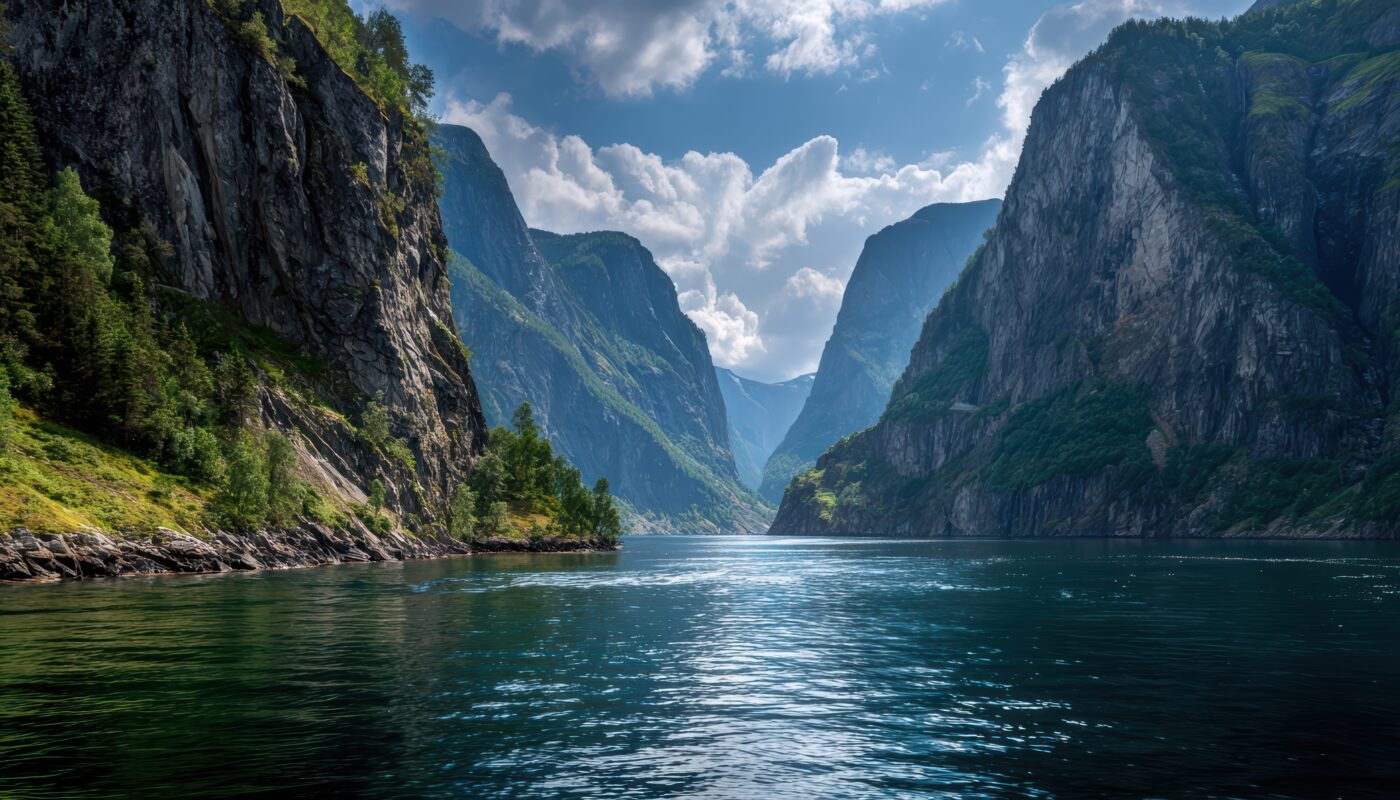
Instead of looking across a broad fjord, photographers often find themselves surrounded by steep mountain walls.
The fjord is a branch of Sognefjord and forms part of the UNESCO-listed West Norwegian Fjords. Its narrow shape and dramatic surroundings make it particularly impressive from the water.
A boat moving through Nærøyfjord can become an excellent scale reference.
The vessel may appear tiny compared with the mountains surrounding it.
This creates an important photography lesson:
Don’t be afraid to include people or boats in enormous landscapes.
A human-scale object can actually make a mountain appear larger because viewers have something familiar with which to compare it.
Photographing From the Water
A fjord cruise gives photographers constantly changing viewpoints.
Instead of waiting for the perfect composition from one location, you can move through the landscape and photograph different mountain formations, waterfalls, farms, and reflections.
Best for: mountain scale, boat photography, narrow compositions, and atmospheric landscapes.
3. Sognefjord: The Giant Photography Region
Sognefjord is so large that it should almost be considered an entire photography destination rather than a single viewpoint.
It is Norway’s longest and deepest fjord, stretching approximately 205 kilometers inland and reaching depths of around 1,300 meters.
Its enormous size means there is no single way to photograph it.
The surrounding region includes:
- Aurlandsfjord
- Nærøyfjord
- Fjærlandsfjord
- Glaciers
- Mountain valleys
- Villages
- Waterfalls
- Agricultural areas
This variety is one of its greatest advantages.
A photographer can spend several days in the Sognefjord region and return home with photographs that look as though they were taken in completely different parts of Norway.
Best for: extended photography trips and variety.
4. Aurlandsfjord: Reflections and Elevated Views
Aurlandsfjord is one of the most visually elegant branches of Sognefjord.
The mountains rise steeply around the water, creating strong vertical lines and beautiful reflections when conditions are calm.
The area is also home to the famous village of Flåm.
One of the most recognizable viewpoints is Stegastein, a striking viewing platform projecting outward above the fjord.
From this position, the water appears far below while the surrounding mountains create layers across the image.
A Creative Tip
Don’t automatically photograph the entire panorama.
Try concentrating on individual details.
A distant boat.
A mountain ridge.
A patch of fog.
A tiny settlement.
A waterfall.
A winding road.
These smaller elements can produce more personal photographs than a standard wide-angle panorama.
Best for: panoramic photography, reflections, mountain layers, and accessible viewpoints.
5. Lysefjord: Cliffs That Create Drama
Lysefjord is particularly attractive to photographers who enjoy dramatic geology.
The fjord is famous for spectacular mountain walls and iconic hiking destinations, including Preikestolen and Kjerag.
Preikestolen
Preikestolen, commonly called Pulpit Rock, is one of Norway’s best-known natural viewpoints.
The enormous rock platform extends above Lysefjord and creates an instantly recognizable composition.
Instead of photographing only the famous rock, experiment with the relationship between the cliff and the water below.
A wide composition can show the scale of the entire fjord.
A tighter composition can emphasize the textures of the rock and mountains.
From the Fjord
Photography from a boat produces another perspective.
The cliffs become much more imposing when viewed from water level.
Best for: dramatic cliffs, adventure photography, hiking landscapes, and powerful compositions.
6. Hardangerfjord: A Colorful Combination of Nature and Agriculture
Hardangerfjord offers a slightly softer visual character than some of Norway’s most rugged fjords.
The region combines dramatic mountains with orchards, waterfalls, villages, and fertile valleys.
It is Norway’s second-longest fjord, extending for roughly 180 kilometers.
One of its greatest photographic attractions is the fruit-growing landscape.
In spring, flowering orchards can create an extraordinary foreground.
Imagine:
blossoming trees → green fields → blue water → dark mountains → white peaks.
This combination creates depth and color without requiring a complicated composition.
Hardanger is also associated with the famous Trolltunga hiking destination.
Best Season
Spring can be particularly rewarding because of the contrast between flowering orchards and lingering snow in the mountains.
Best for: colorful landscapes, orchards, waterfalls, mountains, and seasonal photography.
7. Hjørundfjord: Beauty Without the Same Crowds
Hjørundfjord is an excellent choice for photographers who prefer a quieter atmosphere.
The fjord is surrounded by the dramatic Sunnmøre Alps and offers a combination of sharp peaks, green slopes, water, and small settlements.
Compared with some of Norway’s most famous fjord destinations, Hjørundfjord can feel more peaceful.
That is a major advantage for photographers.
You can spend time observing the landscape instead of constantly trying to remove other visitors from your composition.
The surrounding mountains also provide numerous hiking opportunities.
Best for: solitude, mountain photography, hiking, and less crowded landscapes.
8. Nordfjord: Where Fjords Meet Glaciers
Nordfjord provides another excellent option for photographers who want more than a traditional fjord scene.
The wider region combines:
- Fjord landscapes
- High mountains
- Glaciers
- Waterfalls
- Valleys
- Coastal scenery
This makes Nordfjord particularly useful for photographers planning a longer trip.
One day can be devoted to fjord reflections.
Another can focus on mountain landscapes.
Another can explore glacier scenery.
The result is a much more diverse photographic portfolio.
Best for: photographers who want fjords, mountains, and glaciers in one region.
9. Trollfjord: A Dramatic Northern Landscape
Trollfjord lies in Northern Norway and provides a different atmosphere from the famous fjords of Western Norway.
The fjord is narrow, surrounded by steep mountains, and particularly striking when viewed from the water. It is among the dramatic fjord landscapes highlighted in Northern Norway’s tourism material.
Its northern position provides additional opportunities for unusual lighting.
Depending on the season, photographers may encounter:
- Midnight sun
- Snow-covered mountains
- Autumn colors
- Low-angle sunlight
- Dramatic clouds
- Winter darkness
This makes Trollfjord particularly interesting for photographers who want something visually different from the traditional Geirangerfjord photograph.
Best for: Arctic atmosphere, dramatic mountain walls, and unusual seasonal light.
10. Romsdalsfjord: Mountains as the Main Subject
Romsdalsfjord is another excellent destination for photographers who love mountains.
The surrounding landscape contains impressive peaks that create powerful silhouettes around the water.
Rather than making the fjord itself the main subject, photographers can use the water as a visual pathway leading toward the mountains.
This approach can produce photographs with a strong sense of depth.
Fog and low clouds can make the mountains particularly dramatic.
A peak partially hidden by cloud may actually look more mysterious than one photographed under completely clear skies.
Best for: mountain silhouettes, atmospheric photography, and layered compositions.
The Best Season for Norwegian Fjord Photography
There is no universal best season.
Each season creates a different visual language.
Spring: Snow and Blossoms
Spring is an exciting period for fjord photography.
Lower valleys become green while high mountain areas may remain covered in snow.
Waterfalls can become particularly powerful as seasonal snow melts.
In Hardangerfjord, flowering fruit trees can add vibrant color to the landscape.
This creates a rare combination of winter and spring within a single photograph.
Best subjects: blossoms, waterfalls, snow-covered peaks, and fresh green vegetation.
Summer: Long Days and Easy Exploration
Summer is popular for good reason.
Long daylight hours allow photographers to explore extensively.
Mountain trails are generally more accessible than during winter, and roads provide greater opportunities for road-trip photography.
The disadvantage is that famous locations can become busy.
A simple solution is to photograph early.
Early morning can provide:
- Softer light
- Fewer visitors
- Calmer water
- Atmospheric mist
- Better reflections
You don’t necessarily need to wake up extremely early every day, but popular viewpoints are usually more enjoyable outside peak daytime hours.
Autumn: The Season of Rich Colors
Autumn transforms Norwegian fjords into a palette of gold, orange, red, green, and brown.
The colors of the vegetation contrast beautifully with dark mountain slopes and blue water.
Cloudy conditions can actually improve the experience because soft light reduces harsh shadows.
Rain can also make colors appear more saturated.
For photographers who enjoy mood and atmosphere rather than postcard-perfect sunshine, autumn can be exceptional.
Winter: Minimalism and Silence
Winter produces perhaps the greatest transformation.
Mountains become snow-covered.
Trees lose their leaves.
Waterfalls may partially freeze.
Tourist numbers can fall significantly.
The resulting landscape is often minimalist.
A photograph might contain only:
- White mountains
- Dark rocks
- Blue-gray water
- A small village
This simplicity can create extremely powerful images.
However, winter travel requires careful planning because weather, road conditions, and daylight can vary considerably.
The Best Light for Fjord Photography
Good equipment helps, but light remains one of the most important factors in landscape photography.
Early Morning
Morning light is often soft and gentle.
It can produce excellent reflections and mist.
Late Evening
Low sunlight can illuminate mountain faces while leaving the water in shadow.
This creates depth and contrast.
Blue Hour
The period after sunset can be particularly beautiful around fjord villages.
Artificial lights begin appearing while the sky remains blue.
Cloudy Weather
Don’t automatically put your camera away when the sky turns gray.
Clouds can create texture and atmosphere.
Why Fog Can Improve a Photograph
Fog is often treated as bad weather.
For fjord photography, it can be a gift.
A layer of fog can partially hide mountains, creating a sense of mystery.
Instead of showing everything, the photograph leaves something for the viewer to imagine.
Fog can also separate foreground and background elements, making the image feel deeper.
If you encounter mist during a fjord trip, wait before deciding that the conditions are unsuitable.
The landscape may become more interesting as the weather changes.
Photographing Reflections on Fjord Water
Calm water provides one of the easiest ways to create a visually balanced composition.
When mountains are reflected in the fjord, the image can almost appear symmetrical.
Early morning is often ideal because wind can be lighter.
Try lowering your camera position closer to the water.
This can increase the amount of reflection visible in the frame.
However, don’t force perfect symmetry.
Sometimes a boat, ripple, or small wave makes the photograph more natural and visually interesting.
Include Something Small in a Huge Landscape
Norwegian mountains can be difficult to photograph because they are so large.
A viewer looking at a photograph may not immediately understand the scale.
Adding a small object solves this problem.
Consider including:
- A person
- A kayak
- A ferry
- A cabin
- A road
- A vehicle
A tiny boat surrounded by enormous cliffs instantly communicates scale.
This technique is particularly effective in Nærøyfjord and Lysefjord.
Don’t Forget the Waterfalls
Waterfalls are among the defining visual features of Norwegian fjords.
Geirangerfjord is especially famous for the Seven Sisters and other waterfalls descending from its steep mountains.
When photographing waterfalls, try different approaches.
Wide Composition
Show the waterfall as part of the mountain.
Medium Composition
Include the waterfall and the fjord.
Telephoto Composition
Isolate individual streams and rock textures.
Slow Shutter
A slower shutter speed can create a smoother appearance.
Fast Shutter
A faster shutter can freeze individual drops and preserve detail.
There is no single correct technique.
Photographing From a Boat
A boat provides access to perspectives that cannot be reached from land.
It allows you to photograph:
- Cliffs from below
- Waterfalls from the fjord
- Villages along the shoreline
- Reflections
- Passing boats
- Narrow passages
Keep your camera ready because the composition can change within seconds.
One moment a mountain may be perfectly framed.
A few seconds later, the boat moves and the entire scene changes.
This unpredictability is part of the fun.
Photographing From a Kayak
Kayaking provides an even lower perspective.
The camera sits close to the water, making the fjord appear more immersive.
It is particularly useful for reflection photography.
However, protect your equipment carefully.
Water and expensive camera equipment are not a good combination.
A waterproof camera bag or protective cover can provide additional peace of mind.
Choosing Lenses for Fjord Photography
You do not need an enormous collection of equipment.
A practical kit might include:
Wide-Angle Lens
Useful for large mountains and dramatic foregrounds.
Standard Zoom
Excellent for general travel photography.
Telephoto Lens
Useful for distant waterfalls, mountain details, boats, and compressed layers.
Tripod
Helpful for:
- Low-light photography
- Long exposures
- Waterfalls
- Night photography
- Blue hour
A tripod can also encourage you to slow down and carefully compose your photograph.
Responsible Photography in Norway
Beautiful landscapes attract photographers, but photography should never damage the environment.
Avoid walking through fragile vegetation merely to obtain a better angle.
Stay on appropriate paths where required.
Do not disturb wildlife.
Respect private property.
Follow local regulations.
If you use a drone, make sure you understand the applicable Norwegian aviation and protected-area rules before launching it.
Most importantly, remember that the landscape is more important than the photograph.
A great image should document nature—not damage it.
How to Find Your Own Photogenic Fjord
You do not have to limit yourself to famous locations.
Some of Norway’s best photographs can come from places that are not heavily promoted online.
When exploring, look for:
- Curving shorelines
- Mountain reflections
- Small waterfalls
- Interesting foreground rocks
- Colorful houses
- Roads leading toward mountains
- Boats creating scale
- Mist between peaks
- Contrasting vegetation
Instead of asking, “Where is the most famous viewpoint?”, ask:
“Where can I find the most interesting combination of light, landscape, and composition?”
That change in thinking can transform your photography.
A Quick Comparison of Norway’s Photogenic Fjords
| Fjord | Main Photographic Attraction | Ideal For |
|---|---|---|
| Geirangerfjord | Waterfalls and dramatic viewpoints | First-time visitors |
| Nærøyfjord | Narrow mountain walls | Boat photography |
| Sognefjord | Huge variety | Multi-day trips |
| Aurlandsfjord | Stegastein and reflections | Panoramas |
| Lysefjord | Massive cliffs | Adventure photography |
| Hardangerfjord | Orchards and mountains | Spring photography |
| Hjørundfjord | Peaceful alpine scenery | Solitude |
| Nordfjord | Fjords and glaciers | Diverse landscapes |
| Trollfjord | Arctic mountain scenery | Northern Norway |
| Romsdalsfjord | Dramatic peaks | Mountain compositions |
Final Thoughts
Norway’s fjords are not photogenic for just one reason.
Their beauty comes from the interaction of water, mountains, weather, vegetation, wildlife, villages, waterfalls, and changing light.
Geirangerfjord is an excellent choice for photographers seeking iconic scenery and spectacular waterfalls. Nærøyfjord is ideal for dramatic mountain walls and boat-based compositions. Sognefjord offers enough variety for an extended photography journey, while Aurlandsfjord provides beautiful elevated perspectives and reflections.
Lysefjord appeals to adventure photographers who enjoy dramatic cliffs. Hardangerfjord combines mountain scenery with colorful orchards, particularly during spring. Hjørundfjord offers a quieter atmosphere, while Nordfjord brings glaciers and mountain landscapes into the same photographic journey.
For something different, head north to Trollfjord, where the landscape can take on an Arctic character. Romsdalsfjord is another strong choice for photographers who want mountains to dominate their compositions.
The secret to photographing Norwegian fjords is not simply visiting the most famous places.
It is being patient with the landscape.
Wait for the clouds to move.
Look for reflections.
Watch how sunlight changes a mountain.
Photograph the same scene from the shore and from the water.
Try a telephoto lens instead of automatically reaching for the widest lens.
And don’t be afraid of rain, mist, or snow. In Norway, changing weather is often part of what makes a landscape photograph memorable.
Most importantly, leave room in your itinerary for unexpected discoveries.
A famous viewpoint may give you the photograph you came for, but a quiet road, a small village, or a sudden break in the clouds may give you the photograph you remember for years.
Norway’s fjords are constantly changing.
The best photograph is often the one that captures that change.