by
Norway’s fjords are among the most remarkable natural landscapes in Europe. Towering mountains rise directly from deep blue water, waterfalls pour down steep cliffs, small villages sit beside the shoreline, and narrow valleys disappear into the interior. During summer, these landscapes take on a completely different character. Snow remains on high mountain peaks while lower slopes become intensely green, wildflowers appear along hiking trails, waterfalls swell with melting snow, and the sun can remain visible late into the night.
For travelers planning a fjord adventure, summer is one of the most rewarding seasons to explore Norway’s fjords. Longer daylight hours make it easier to combine scenic drives, boat trips, hiking, kayaking, cycling, and village visits in a single day. In northern Norway, the midnight sun creates an especially unusual experience, allowing travelers to enjoy outdoor scenery long after the time when darkness would normally arrive.
From the famous Sognefjord and Geirangerfjord to the dramatic landscapes around Hardangerfjord and the less-visited fjords farther north, summer reveals a greener and more accessible side of Norway.
What Makes Summer Special in the Norwegian Fjords?
Summer in the Norwegian fjords is not simply warmer winter scenery. The entire landscape changes.
During the warmer months, snow retreats from lower elevations and vegetation returns to the valleys. Mountain slopes become green, waterfalls become more prominent, and farms and villages appear surrounded by lush vegetation.
Daylight is also dramatically extended.
In southern Norway, summer days can remain bright well into the evening. Farther north, areas above the Arctic Circle experience the midnight sun, when the sun remains above the horizon for part or all of the night around the summer solstice.
This combination of greenery, long daylight, and accessible mountain routes makes summer particularly attractive for outdoor travelers.
When Is Summer in the Norwegian Fjords?
Norwegian summer is generally considered to run from June through August, although conditions vary considerably depending on location and elevation.
June
June brings very long days, fresh greenery, melting snow, and powerful waterfalls. Mountain trails at higher elevations may still have snow, so hiking conditions can vary.
July
July is typically one of the busiest periods for fjord tourism. Many hiking routes are more accessible, temperatures are generally comfortable for outdoor activities, and the valleys are at their greenest.
August
August can still provide excellent fjord conditions, although daylight gradually decreases. Some areas become slightly quieter toward the end of the month.
For travelers who want a combination of long daylight and fewer crowds, the beginning or end of the main summer season may be worth considering.
The Midnight Sun Experience
One of the most extraordinary summer experiences in Norway is the midnight sun.
The phenomenon occurs because Earth’s axis is tilted relative to its orbit around the Sun. During the northern summer, areas within the Arctic Circle can experience periods when the sun does not fall below the horizon.
The exact duration depends on latitude.
The farther north you travel, the longer the period of continuous daylight.
This means northern Norwegian destinations can offer extraordinary opportunities for evening hikes, photography, kayaking, boat trips, and sightseeing.
Instead of finishing outdoor activities when the sun goes down, travelers may find themselves continuing well into the night.
Is There a Midnight Sun in Every Norwegian Fjord?
No.
This is an important distinction.
Not every famous Norwegian fjord lies far enough north to experience a true midnight sun.
Many popular fjords in western Norway are south of the Arctic Circle. They still experience extremely long summer days, but the sun does technically set.
For example, travelers around Bergen, Sognefjord, Hardangerfjord, and Geirangerfjord can enjoy very late sunsets and long twilight conditions without experiencing the same continuous sunlight found in northern Norway.
If experiencing the actual midnight sun is a major goal, you should plan a trip to a destination north of the Arctic Circle.
The Green Valleys of Western Norway
One of the most beautiful aspects of summer in the fjords is the transformation of the valleys.
After the winter and spring snowmelt, the landscape becomes intensely green.
Grass covers the lower slopes.
Trees grow along riverbanks.
Wildflowers appear in open areas.
Waterfalls become more dramatic as snow and ice melt at higher elevations.
Small farms may be surrounded by bright vegetation, creating a striking contrast with the darker mountains.
The combination of green valleys and towering rocky peaks is one of the defining visual characteristics of summer in western Norway.
Sognefjord: Norway’s Longest Fjord
Sognefjord is one of the most famous fjord destinations in Norway.
It extends deep into the country and is surrounded by mountains, villages, waterfalls, agricultural landscapes, and numerous side fjords.
Summer is an excellent time to explore the region because travelers can combine several forms of transportation.
A typical journey might include:
- Train travel
- Scenic driving
- Fjord cruises
- Hiking
- Cycling
- Kayaking
- Village exploration
The surrounding landscape also includes areas where glaciers and high mountain terrain remain visible during summer.
One advantage of Sognefjord is its size. Travelers can spend several days exploring different branches rather than treating the fjord as a single sightseeing destination.
Geirangerfjord in Summer
Geirangerfjord is perhaps one of the most recognizable fjord landscapes in Norway.
Steep mountains surround the water, while famous waterfalls cascade down the cliffs.
During summer, the contrast between green mountainsides, dark rock, blue water, and white waterfalls creates spectacular scenery.
Popular viewpoints around the region offer dramatic perspectives over the fjord.
Summer is also a popular season for boat excursions, hiking, sightseeing drives, and photography.
Because Geirangerfjord attracts many visitors, travelers looking for a quieter experience may want to explore during early morning or later in the evening.
The long summer daylight makes this particularly practical.
Hardangerfjord and the Fruit-Bearing Valleys
Hardangerfjord is especially interesting during spring and summer because of its agricultural landscapes.
The region is known for fruit cultivation, particularly apples, pears, cherries, and plums.
When the season is right, orchards create colorful scenery along the fjord.
The surrounding mountains provide a dramatic backdrop, while waterfalls and rivers add movement to the landscape.
A summer journey through Hardangerfjord can therefore feel quite different from a purely mountainous fjord experience.
Here, agriculture, villages, water, forests, and mountains exist within the same landscape.
Northern Fjords and the Midnight Sun
Travelers who want to combine fjords with the midnight sun should consider northern Norway.
Areas such as the Lofoten region, Vesterålen, and parts of Troms and Finnmark provide opportunities to experience dramatic coastal landscapes under continuous or near-continuous summer daylight.
Northern fjords can look particularly spectacular under the low-angle light of late evening.
Mountains cast long shadows across the water, while clouds can develop beautiful colors around the horizon.
Even when the sun does not technically remain above the horizon at a particular destination, the extended twilight can create remarkably bright conditions.
Why Summer Is Excellent for Fjord Hiking
Many travelers visit Norway specifically to hike.
Summer provides the longest practical window for many hiking routes, although conditions still vary by altitude.
Popular hiking destinations include trails around:
- Geirangerfjord
- Sognefjord
- Hardangerfjord
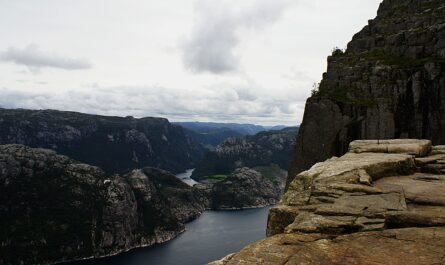
- Lysefjord
- Lofoten
- Jotunheimen
Some routes are short and suitable for casual walkers.
Others involve steep climbs, uneven terrain, exposed sections, and substantial elevation gain.
Travelers should never assume that a trail is safe simply because it is summer.
Snow can remain at high elevations, and rain can make rocks slippery.
Hiking Under the Midnight Sun
Midnight-sun hiking can be an unforgettable experience.
Instead of starting a hike early in the morning, travelers can begin later in the evening.
The landscape may appear almost surreal as the sun moves low across the horizon without disappearing.
This can also provide a quieter alternative to hiking during the busiest daytime hours.
However, hikers should still prepare properly.
Bring:
- Warm layers
- Waterproof clothing
- A headlamp
- Food and water
- Navigation equipment
- Fully charged phone
- Emergency supplies appropriate to the route
Even with constant daylight, mountain weather can change rapidly.
Summer Waterfalls in the Fjords
Waterfalls are another major highlight of summer.
Many Norwegian waterfalls receive water from snowfields, glaciers, lakes, and mountain streams.
As temperatures rise, snowmelt increases.
This can produce impressive flows, especially during the early summer period.
Some waterfalls are permanent and flow throughout the year, while others are strongly influenced by seasonal melting.
The result is a landscape filled with cascading water.
From a boat on a fjord, travelers may see waterfalls dropping hundreds of meters from seemingly inaccessible cliffs.
Kayaking in the Norwegian Fjords
Summer conditions can be ideal for kayaking when weather and water conditions are suitable.
Paddling provides a completely different perspective from a cruise ship or road.
From water level, the cliffs appear even taller.
Travelers can observe waterfalls, rocky shorelines, small beaches, forests, and quiet coves at close range.
However, fjord water can remain extremely cold even during summer.
Kayaking should therefore be undertaken with appropriate equipment and, for inexperienced paddlers, professional guidance.
Wind and weather can also change conditions quickly.
Cycling Through Fjord Landscapes
Cycling can be another rewarding way to explore Norway’s fjord regions.
Some routes pass through small villages, agricultural valleys, tunnels, mountain roads, and coastal landscapes.
Electric bicycles have also made some challenging routes more accessible.
However, travelers should research routes carefully.
Norwegian mountain roads can include steep climbs, narrow sections, tunnels, and unpredictable weather.
Cyclists should also be aware that roads shared with vehicles require appropriate safety precautions.
Scenic Fjord Cruises in Summer
Cruising is one of the easiest ways to appreciate the scale of the fjord landscape.
A boat allows travelers to move through the center of a fjord while looking upward at cliffs rising on both sides.
Summer cruises may operate on popular fjords as well as smaller waterways.
A cruise can be particularly useful for travelers who want dramatic scenery without undertaking a difficult hike.
For a more active experience, smaller boats and guided kayaking excursions can provide a closer connection with the landscape.
Driving Through the Norwegian Fjords
A road trip offers flexibility that organized cruises cannot always provide.
Travelers can stop at viewpoints, villages, waterfalls, farms, and trailheads along the way.
Some scenic roads are destinations in themselves.
However, driving through fjord country requires patience.
Distances on a map can be misleading because mountains and waterways make routes winding.
Ferries may also be part of the journey.
Travelers should allow extra time for:
- Ferry crossings
- Scenic stops
- Narrow roads
- Weather delays
- Mountain traffic
- Hiking detours
Trying to cover too much territory in one day can reduce the enjoyment of the trip.
The Best Way to Combine Fjord Experiences
One of the advantages of summer travel is the ability to combine multiple activities.
For example, a day might look like this:
Morning: Scenic drive through a mountain valley
Afternoon: Fjord cruise
Evening: Short hike to a viewpoint
Late evening: Dinner beside the water
In northern Norway, the evening could continue with a midnight-sun hike or photography session.
This flexibility is one of the biggest advantages of traveling during the bright season.
Summer Weather in the Norwegian Fjords
Summer does not mean guaranteed sunshine.
The fjord regions can experience rain, wind, fog, cool temperatures, and sudden changes in mountain weather.
One day can be bright and warm, while the following day may be cloudy and wet.
Travelers should therefore pack for changing conditions.
Useful clothing includes:
- Waterproof jacket
- Lightweight insulating layer
- Hiking trousers
- Moisture-wicking base layers
- Comfortable walking shoes
- Hat
- Gloves
- Sunglasses
Layering is particularly useful because temperatures can vary significantly between valleys and higher elevations.
What to Pack for a Summer Fjord Trip
A good packing list should balance comfort, weather protection, and outdoor practicality.
Consider bringing:
Clothing
- Waterproof outer layer
- Warm fleece or light jacket
- Comfortable trousers
- Base layers
- Extra socks
Hiking Equipment
- Hiking shoes or boots
- Small backpack
- Reusable water bottle
- Navigation tools
- Headlamp
Photography
- Camera or smartphone
- Spare battery
- Power bank
- Lens cloth
- Waterproof protection
Everyday Items
- Sunscreen
- Sunglasses
- Insect repellent
- Personal medications
- Travel documents
The long daylight can make it easy to forget about time, so having enough food and water is especially important during long outdoor days.
Summer Crowds in the Norwegian Fjords
Summer is also the busiest tourism period in many popular fjord destinations.
Major viewpoints, cruises, parking areas, and hiking trails can become crowded during peak periods.
If you prefer a quieter experience, consider traveling during the shoulder periods of late spring or early autumn, depending on the destination and conditions.
During summer itself, early morning and late evening can be excellent times for sightseeing.
The long daylight makes it possible to explore outside traditional daytime hours.
How to Experience the Fjords More Sustainably
Norway’s fjord environments are valuable natural and cultural landscapes.
Travelers can reduce their impact by:
- Staying on marked trails
- Taking public transportation where practical
- Avoiding litter
- Respecting wildlife
- Following local camping rules
- Supporting local businesses
- Avoiding unnecessary disturbance of vegetation
- Using refillable water bottles
- Following access restrictions
Responsible tourism helps protect the landscapes that attract visitors in the first place.
Summer Photography in the Fjords
The extended daylight provides photographers with extraordinary opportunities.
Instead of concentrating only on midday photography, consider shooting during the softer light of early morning or late evening.
The low summer sun can illuminate mountain faces while leaving parts of the fjord in shadow.
Useful subjects include:
- Waterfalls
- Reflections
- Green valleys
- Mountain silhouettes
- Fishing villages
- Boats
- Snow-covered peaks
- Wildflowers
In northern Norway, the midnight sun can produce hours of unusual golden and pastel light.
A tripod can be helpful for longer exposures, especially in low-light evening conditions.
How Many Days Do You Need?
The ideal length depends on how much of Norway you want to explore.
Three to Four Days
Suitable for focusing on one fjord region.
Five to Seven Days
Allows travelers to combine several destinations and activities without rushing excessively.
Ten Days or More
Provides greater flexibility for combining western fjords with northern Norway, mountain areas, scenic rail journeys, and coastal destinations.
One common mistake is trying to visit too many fjords in a short period.
Because roads and waterways can make travel slower than expected, spending more time in fewer locations can create a more relaxed experience.
Tips for Planning a Summer Fjord Adventure
A successful trip begins with realistic planning.
First, choose the type of experience you want.
Do you prefer:
- Hiking?
- Scenic drives?
- Cruises?
- Photography?
- Kayaking?
- Villages and culture?
- The midnight sun?
Then select a region that matches those interests.
If the midnight sun is your priority, travel north of the Arctic Circle during the appropriate summer period.
If lush valleys, orchards, waterfalls, and classic western fjord scenery are more important, western Norway offers numerous possibilities.
Always check current weather, road, ferry, trail, and attraction information before setting out.
Final Thoughts
Norwegian fjords in summer offer a remarkable combination of mountains, water, greenery, waterfalls, wildlife, villages, and extraordinary daylight.
The season transforms the landscape.
Snow remains on high peaks while lower valleys become green. Waterfalls become more dramatic with snowmelt. Hiking trails become more accessible in many areas, and long daylight hours allow travelers to explore well into the evening.
For those heading north, the experience becomes even more unusual with the midnight sun. Instead of darkness bringing the day to an end, the landscape can remain illuminated late into the night, creating opportunities for hiking, photography, kayaking, and quiet sightseeing at unusual hours.
A summer fjord journey does require preparation. Weather can change quickly, popular destinations can become busy, and mountain conditions may remain challenging even during the warmest months. But with flexible planning, suitable clothing, and respect for the environment, summer can provide an extraordinary way to experience Norway’s fjord country.
The most memorable moments may not necessarily come from the most famous viewpoints. They might happen while watching a waterfall from a quiet boat, walking through a green valley, cycling beside the water, or standing on a mountain trail as the midnight sun casts a soft glow across the fjord.
That combination of endless daylight, green valleys, snow-covered mountains, and deep coastal waters is what makes a Norwegian summer so distinctive—and why the fjords remain one of Europe’s most compelling natural landscapes.