 by
Norway’s fjords are famous for their dramatic combination of towering mountains, deep waterways, waterfalls, rocky cliffs, and enormous open landscapes. For hikers, these surroundings create some of Europe’s most memorable mountain experiences. Trails such as Preikestolen, Trolltunga, and Kjerag have become internationally recognized attractions, drawing visitors from around the world.
Their popularity, however, creates a problem for travelers looking for peace and solitude.
During the busiest periods, you may find yourself sharing a narrow trail with large groups, waiting to take a photograph at a famous viewpoint, or arriving at a parking area that is already full. Norway’s most iconic hikes can become particularly busy from around mid-June through the end of August. Official tourism guidance recommends considering weekdays and periods outside the main tourist season if you want a quieter experience.
The good news is that you do not necessarily have to give up Norway’s famous fjord landscapes to escape the crowds.
With the right timing, flexible planning, alternative destinations, and proper preparation, it is possible to experience these spectacular mountains in a much calmer atmosphere.
Why Are Famous Fjord Hikes So Busy?
Before learning how to avoid crowds, it helps to understand why they appear in the first place.
Norway has thousands of hiking routes, but international visitors tend to concentrate around a relatively small collection of famous viewpoints.
A photograph of a person standing above a dramatic fjord can inspire thousands of travelers to visit exactly the same location.
Several factors contribute to this concentration.
Social Media
Platforms such as Instagram, YouTube, TikTok, Pinterest, and travel blogs have transformed certain mountain viewpoints into global attractions.
A single recognizable rock formation can become more famous than an entire mountain region.
Short Travel Seasons
Some high-altitude Norwegian trails are accessible only during relatively favorable weather conditions.
As a result, visitors often concentrate their trips between late spring and early autumn.
Cruise Tourism
Cruise ships bring large numbers of travelers into certain fjord communities. When a ship arrives, popular attractions in the surrounding region can experience a sudden increase in visitors.
Organized Tours
Coach tours, shuttle services, and guided excursions make famous trails accessible to travelers who might otherwise not attempt them independently.
Iconic Photo Locations
Some trails become crowded because everyone is heading toward the same small viewpoint.
The trail itself may be relatively spacious, but the final rock formation can become congested because visitors stop for photographs.
Choose Your Dates Strategically
One of the simplest ways to reduce crowds is to reconsider the date of your hike.
The main summer season is generally the busiest period for Norway’s famous trails. Official Norwegian tourism guidance notes that iconic hikes can become crowded during the height of the tourist season, particularly from mid-June through August.
If your travel schedule is flexible, consider visiting during a shoulder period.
Late Spring
Late spring can provide longer daylight and fewer visitors than the heart of summer.
However, mountain conditions can still be challenging.
Snow may remain at higher elevations, trails can be wet or muddy, and some transportation services may operate on reduced schedules.
Therefore, a quieter spring trail is not necessarily an easier trail.
Early Autumn
Early autumn can be particularly attractive.
The landscape begins changing color, temperatures are often more comfortable for hiking, and visitor numbers can decrease after the summer peak.
September can provide an interesting combination of mountain scenery and a quieter atmosphere, but conditions must still be checked carefully.
Weekdays
If you have to travel during summer, choose a weekday whenever possible.
Norway’s official tourism guidance specifically recommends weekdays as one way to encounter fewer people on popular hikes.
A Tuesday or Wednesday morning can feel very different from a sunny Saturday afternoon.
Start Early — Really Early
Early starts are among the most effective crowd-avoidance strategies.
However, there is a difference between arriving early and arriving before the majority of visitors have even started their day.
For a popular hike, reaching the trailhead at 9:00 a.m. may already put you behind many other hikers.
If conditions and your experience allow it, consider beginning around sunrise or earlier.
This strategy has several benefits:
- Fewer hikers on the trail
- Cooler temperatures
- Softer morning light
- Better photography conditions
- More time available for the return journey
- Less congestion around viewpoints
For example, official guidance for Trolltunga recommends beginning before 8 a.m. during the main hiking season because the hike is long and demanding.
Early starts are particularly useful for long hikes because they are not simply about avoiding people. They also provide more time to deal with unexpected delays.
Consider a Late-Afternoon Hike
An early morning isn’t the only option.
During Norway’s long summer days, there can be enough daylight for a late-afternoon hike, depending on the route and conditions.
Preikestolen’s official guidance specifically suggests starting early or hiking later in the afternoon during summer if you want to avoid some of the crowds.
A late start can also provide attractive evening light.
However, you must calculate the entire journey carefully.
Ask yourself:
- How long is the round trip?
- How quickly do I normally hike?
- Will weather slow me down?
- What time will darkness arrive?
- Do I have a headlamp?
- Is the trail suitable for an afternoon start?
Do not start a demanding mountain hike late simply because you want an empty trail.
The objective is fewer people without compromising safety.
Preikestolen: Visit Outside the Midday Rush
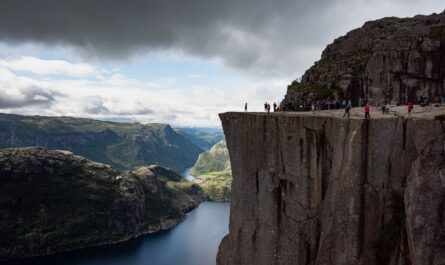
Preikestolen, also known as Pulpit Rock, rises approximately 604 meters above Lysefjord.
The hike is around 8 kilometers round trip and generally takes about four hours. The destination attracts hundreds of thousands of visitors annually, making it one of Norway’s busiest mountain attractions.
The most straightforward strategy is to avoid the middle of the day.
Better Timing for Preikestolen
Consider:
Option 1: Very early morning
Option 2: Late afternoon during a period of long daylight
Option 3: A weekday outside the busiest summer period
The official destination guidance specifically recommends early morning or late-afternoon hiking for visitors trying to avoid summer crowds.
If you are visiting outside the main season, remember that conditions can become significantly more difficult.
Preikestolen can be reached year-round, but winter hiking requires appropriate equipment, and local guidance recommends additional preparation and guiding for winter conditions.
Trolltunga: Plan Around the Length of the Hike
Trolltunga is one of Norway’s most recognizable mountain formations.
The dramatic rock ledge extends above Ringedalsvatnet and has become one of the country’s most photographed natural attractions.
It is also a serious hike.
From the main trailhead at Skjeggedal, the round trip is about 27 kilometers and can take roughly 10–12 hours including breaks. The alternative trailhead at Mågelitopp reduces the journey to approximately 20 kilometers, with an estimated hiking time of 7–10 hours.
This means crowd avoidance should not be your only reason for starting early.
Starting early gives you a larger safety margin.
How to Reduce Crowds at Trolltunga
Try to:
- Begin before 8 a.m.
- Choose a weekday
- Avoid the busiest summer weekends
- Allow additional time for weather delays
- Consider staying locally before the hike
- Check current trail conditions
- Consider a guide if you lack high-mountain experience
The official guidance identifies June through August as the main hiking season and recommends guided hiking during winter.
Because Trolltunga involves exposed high-mountain terrain, solitude should never take priority over preparation.
Kjerag: Avoid the Popular Weekend Window
Kjerag is another legendary destination above the Lysefjord.
The hike leads toward Kjeragbolten, the famous boulder wedged into a mountain crevice.
The round trip is approximately 11 kilometers and typically takes around six hours, although conditions and individual hiking speed can change the duration. The route is physically demanding, with substantial elevation gain.
According to official destination guidance, most visitors arrive during summer weekends, making off-peak travel a useful strategy for reducing congestion.
A Practical Kjerag Strategy
Consider visiting:
- On a weekday
- Early in the day
- Outside the middle of summer
- When weather conditions are stable
The normal hiking season is May through October, while winter hiking is not recommended without appropriate experienced guidance.
The road to the Kjerag area is also seasonal, so transportation should be checked before your trip.
Look Beyond the Famous Photograph
One of the biggest mistakes travelers make is assuming that the iconic viewpoint is the entire hiking experience.
It isn’t.
The famous rock may occupy only a tiny portion of a much larger landscape.
Instead of spending hours waiting for a photograph, take time to observe the surrounding terrain.
Look for:
- Smaller viewpoints
- Waterfalls
- Mountain lakes
- Valleys
- Forest sections
- Local farms
- Wildlife
- Changing weather
- Fjord reflections
You may discover that the most memorable photograph is not the one everyone else is taking.
Explore Less-Famous Trails
Norway offers an enormous number of hiking possibilities beyond Preikestolen, Trolltunga, and Kjerag.
Official tourism guidance emphasizes that Fjord Norway has many lesser-known hikes with impressive scenery.
These alternatives can provide similar experiences without the same level of congestion.
A quieter hike might not have an internationally famous name, but it could offer:
- A panoramic fjord view
- A mountain waterfall
- A peaceful forest
- A high-altitude lake
- Dramatic cliffs
- Local wildlife
- Better opportunities for photography
The advantage is that you may experience the scenery rather than spend your day managing crowds.
Consider Nordfjord and Sunnfjord
Travelers often focus heavily on Norway’s most famous fjords.
But western Norway contains many other spectacular regions.
For example, Nordfjord and Sunnfjord can provide dramatic mountain and fjord landscapes without requiring you to follow the same tourist circuit as everyone else.
Exploring alternative regions is particularly useful if your main objective is tranquility.
Instead of asking:
“Where is Norway’s most famous hike?”
ask:
“Where can I experience the type of landscape I love?”
That question gives you a much larger selection of destinations.
Check Cruise Ship Activity
Cruise traffic can have a major effect on visitor numbers in popular fjord destinations.
A village may feel relatively quiet on one day and significantly busier when one or more large ships are in port.
If you are planning to hike near a cruise destination, check the local cruise schedule where possible.
If several ships are expected, consider:
- Visiting the trail on another day
- Hiking early
- Exploring a less-famous route
- Choosing a different nearby destination
This can be particularly helpful around major fjord tourism centers.
Stay Near Your Hiking Destination
Accommodation location can have a surprisingly large influence on crowd avoidance.
Suppose you stay two hours away from a trail.
You may naturally arrive later because of breakfast, transportation, parking, and travel time.
By staying closer to the trailhead, you gain flexibility.
You can:
- Wake early.
- Check the weather.
- Eat breakfast.
- Reach the trailhead before major groups.
- Complete the hike.
- Return to your accommodation without a long drive afterward.
This is especially useful for demanding hikes such as Trolltunga.
Use Transportation to Your Advantage
Transportation can determine when you are able to begin.
Some famous hiking destinations have seasonal buses, shuttles, ferries, or other transportation connections.
For Kjerag, for example, visitors can use seasonal transport options toward Lysebotn and the trail area, and advance booking is recommended during high season.
Research transportation before choosing your hiking time.
There is little advantage in planning a sunrise hike if the first available bus does not reach the trailhead until several hours later.
If you have a rental car, check parking rules and capacity rather than assuming that a space will always be available.
Choose the Weather Window, Not Just the Date
Crowd avoidance should work together with weather planning.
A rainy Tuesday may be quieter than a sunny Saturday, but that does not automatically make it a better hiking day.
Mountain weather can change quickly.
Before setting out, check:
- Temperature
- Rain
- Wind
- Visibility
- Snow
- Ice
- Avalanche information where relevant
- Trail conditions
Norway’s mountain safety guidance emphasizes checking weather and adapting your plans to current conditions.
If the weather is unsuitable, postpone the hike.
A spectacular landscape will still be there another day.
Don’t Choose Winter Just to Escape Visitors
Winter can dramatically reduce visitor numbers.
But winter mountains introduce additional hazards.
Snow and ice can obscure paths, reduce visibility, increase slipping risks, and make navigation considerably harder.
Some famous hikes are specifically unsuitable for independent winter hiking.
For example, official guidance recommends guided hiking at Trolltunga during the winter season, while Kjerag is not recommended as a winter hike.
Therefore:
Fewer people does not mean fewer risks.
If you want a winter fjord experience, choose an activity and route appropriate for winter conditions rather than simply attempting a summer trail in snow.
Consider Sunrise and Sunset Photography
If photography is one of your main reasons for hiking, unusual hours can be particularly rewarding.
Sunrise can provide:
- Soft light
- Long shadows
- Calm water
- Atmospheric mountains
- Fewer visitors
Late-day light can offer:
- Golden tones
- Dramatic clouds
- Longer shadows
- Changing colors
- A quieter viewpoint
But always calculate your return time.
Carry a headlamp if there is any possibility of finishing after daylight.
Never let the desire for an empty viewpoint cause you to underestimate the return journey.
Don’t Follow the Crowd Blindly
If you arrive at a trail and see hundreds of people heading toward one viewpoint, consider whether that destination is really your only option.
Sometimes the quieter experience is found by changing the plan.
You might choose:
- A nearby waterfall
- A shorter local trail
- A fjord cruise
- A scenic viewpoint accessible by road
- A village walk
- A less-famous mountain route
This is especially useful when weather or visitor numbers make your original plan less appealing.
Flexibility is one of the strongest tools a traveler can have.
Give Yourself Two Possible Hiking Days
If a particular hike is extremely important to you, avoid scheduling it on only one specific day.
Instead, build some flexibility into your itinerary.
For example:
Day 1: Main fjord hike
Day 2: Scenic fjord exploration
Day 3: Backup hiking day
If weather or crowd levels are unfavorable on Day 1, you can switch your plans.
This approach is especially useful for demanding hikes where weather can have a major influence on the experience.
Don’t Leave the Marked Trail to Escape Crowds
It may be tempting to step away from a busy path and create your own route.
Don’t.
Creating unofficial shortcuts can damage vegetation, increase erosion, and potentially put you in dangerous terrain.
Norway’s right-to-roam guidance encourages visitors to stay on marked paths where appropriate, leave no trace, respect wildlife, and plan their journeys responsibly.
The goal is to avoid crowds through planning, not by damaging the landscape.
Travel Light but Pack Properly
A quieter trail can sometimes mean you are hiking outside the most predictable conditions.
That makes proper equipment even more important.
Depending on the season and route, your backpack should include:
- Waterproof jacket
- Warm layers
- Proper hiking boots
- Food
- Water
- Navigation equipment
- First-aid supplies
- Fully charged phone
- Power bank
- Headlamp
- Extra clothing
- Map and compass where appropriate
Official Norwegian hiking guidance emphasizes proper footwear, essential equipment, food, water, and preparation for changing mountain weather.
Do not assume that a famous trail is automatically easy simply because thousands of tourists hike it.
Consider a Local Guide
A guide may seem unnecessary when your primary goal is avoiding crowds.
In reality, a local guide can sometimes help you choose better timing and routes.
A knowledgeable guide may know:
- Current trail conditions
- Seasonal hazards
- Weather patterns
- Quieter alternatives
- Transportation options
- Safe viewpoints
- When certain areas are busiest
Guided hiking is also particularly relevant on challenging or seasonal routes.
For Trolltunga, official guidance recommends guided hiking for less experienced visitors and during winter.
Respect the Landscape
Crowd avoidance is not only about your personal experience.
It is also about protecting the places you came to see.
Popular Norwegian trails have experienced increasing visitor pressure, including wear and tear and litter. National Scenic Hikes have been established partly to manage heavily visited routes and protect their natural and cultural qualities.
Responsible hikers should:
- Carry their rubbish out
- Stay on appropriate paths
- Avoid disturbing wildlife
- Respect private property
- Use toilets where provided
- Avoid unnecessary noise
- Follow local regulations
- Leave plants, rocks, and natural features undisturbed
A quiet hike is much more valuable when the landscape remains beautiful for future visitors.
A Practical Strategy for Each Famous Hike
Here’s a simple planning framework.
| Hike | Crowd-Avoidance Strategy |
|---|---|
| Preikestolen | Weekday, early morning or late afternoon |
| Trolltunga | Start early, avoid peak periods, consider a guide |
| Kjerag | Avoid summer weekends and travel during off-peak hours |
| Geiranger-area hikes | Check cruise activity and consider alternative trails |
| Other Fjord Norway hikes | Explore lesser-known routes and smaller communities |
The exact conditions vary by season, so always verify current local information before setting out.
The Best Time for a Quiet Fjord Hike
There is no universal answer because crowd levels depend on the trail, weather, transportation, and season.
But a useful general strategy is:
For summer
Choose a weekday + early morning.
For late summer
Consider early September + weekday.
For photography
Consider sunrise or late afternoon, provided the route can be completed safely.
For winter
Choose only routes that are appropriate for winter and use a guide when local guidance recommends one.
For maximum flexibility
Stay nearby and reserve at least two potential hiking days.
What If the Famous Trail Is Still Crowded?
Sometimes you will do everything right and still encounter crowds.
That is simply part of visiting a world-famous landscape.
If this happens, don’t let the crowd ruin the entire experience.
Move away from the main viewpoint when possible.
Spend time observing the fjord.
Take photographs of the landscape rather than only the famous rock.
Talk to other hikers.
Enjoy the trail itself.
And remember that Norway contains thousands of other mountains and paths.
One crowded viewpoint does not define the entire hiking experience.
The Quietest Experience May Be Somewhere You Didn’t Plan to Visit
Perhaps the most useful lesson is that Norway’s fjords are much larger than their famous photographs suggest.
Preikestolen is spectacular, but it is not the entire Lysefjord.
Trolltunga is extraordinary, but it is only one feature within a vast mountain landscape.
Kjerag is remarkable, but the Lysefjord region contains many other trails and viewpoints.
Norway’s official tourism guidance highlights the availability of numerous hikes beyond the iconic routes.
Sometimes the best strategy is therefore not to find a secret time to visit the famous trail.
It is to find a beautiful trail that isn’t famous.
Final Thoughts
Avoiding crowds on Norway’s most popular fjord hikes is largely a matter of smart timing and flexible planning.
Travel outside the busiest summer period when conditions permit. Choose weekdays instead of weekends. Start early or use a safe late-afternoon window. Check cruise schedules around heavily visited fjord destinations. Stay close to trailheads when possible, and keep alternative hiking options available.
For iconic routes such as Preikestolen, Trolltunga, and Kjerag, official Norwegian guidance provides specific recommendations about timing, trail difficulty, seasons, transportation, and mountain safety.
Most importantly, do not trade safety for solitude.
A quiet mountain trail is wonderful, but changing weather, snow, darkness, exposed terrain, and poor visibility can turn a peaceful hike into a dangerous situation. Proper clothing, navigation, food, water, and knowledge of current conditions should always come before crowd avoidance.
And if a famous trail is simply too busy, don’t be afraid to change your plan.
Norway’s fjord country offers far more than its most photographed viewpoints. A lesser-known trail, a quiet valley, a small waterfall, or an overlooked mountain viewpoint may ultimately give you the experience you were hoping to find: not just a photograph of Norway, but a genuine opportunity to slow down and experience its mountains.
That is often the best way to enjoy the fjords — not by trying to eliminate every other traveler, but by choosing the right place, the right time, and the right pace for your journey.